
Coaching
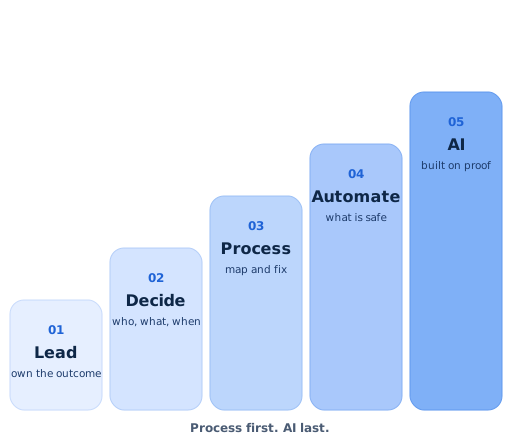
Good process makes good AI.
Bad process multiplies the problem.
AI is a force multiplier. Give it a clear decision and a proven process and you get work that is faster and easier to defend. Give it a broken one and you get the same mistakes, at speed. I have spent 35 years in software and process automation. I coach leaders to fix the decisions and the process first, then add AI.
Why this is not just about AI
AI does not fix a process.
It runs it faster.
Most AI projects start with the tool. The tool is the easy part. The hard part is deciding what should happen, who decides, and what the steps are when things go well and when they do not. Software and process automation taught me that long before AI arrived: automate a confused process and you get a confused process that never sleeps.
So we start where the results come from. Your leadership, your decisions, your process. AI comes last, and it comes in on solid ground.
The coaching process
Five steps.
Leadership to implementation.
Lead: decide what you want to be different
We begin with outcomes, not tools. What should be faster, safer or better a year from now, and who owns each result? You leave this step with a short list of outcomes and a name beside each one.
Decide: design the decisions
This is decision architecture. For each decision that matters we settle who makes it, what information it needs, what rule applies, what a person must always review, and what happens when the answer is unclear. Decisions designed once can be repeated, explained and later automated.
Map: see the process as it really runs
We map the steps, the handoffs, the exceptions and the workarounds, as the work is actually done and not as the manual says. This is where the waste, the delays and the hidden risks show up, and where most leaders are surprised.
Fix: improve the process before you automate it
Remove steps that add nothing. Simplify what remains. Write the rules and the exceptions down. Define what “done well” looks like so you can measure it. A process that works by hand is ready for automation. One that does not is not.
Implement: add AI where it is safe and earns its place
Now we choose where AI fits, and at which level: read, draft, change, or send. Reading and drafting can run on their own. Changes and sends keep a person’s approval. We start small, check the results against the measure from step 4, and widen only what has proven itself.
Steps 1 to 5 repeat. Each new process goes through the same path, and each one gets quicker because the decisions and the method are already in place.
Decision architecture
Questions we answer
for every decision that matters.
Who owns it?
One named person who can explain the decision and stands behind it.
What does it need?
The information and inputs the decision depends on, and where they come from.
What is the rule?
The criteria in plain language, so two people reach the same answer.
When does a person step in?
The cases that always need human judgment, and the cases that can run on their own.
How will we know it worked?
The measure that tells you the decision, and the process behind it, is doing its job.
What if it is wrong?
How errors are caught, corrected and learned from, before they reach a client or a board.
What you walk away with
Working tools,
not a slide deck.
A decision map
Your key decisions, each with an owner, a rule and a clear point where a person steps in.
A mapped, simplified process
Your first process drawn as it really runs, with the waste removed and the exceptions written down.
A place for AI, with limits
Where AI fits in that process, what it may touch, and what always needs a person’s yes.
A review habit and a measure
How you check AI-assisted work, and the number that shows whether it is helping.
A good fit
- Owners and senior leaders of small and mid-sized firms
- Leadership teams that want one shared way to decide and to use AI
- Executives accountable to a board, partners or clients for how AI is used
- Anyone who wants AI to make a good process faster, not a bad one worse
Not a fit
- Looking for a tool to run on autopilot
- Wanting AI to make decisions for you
- Hoping to skip the process work
- Hoping for a guaranteed outcome. Results depend on the work you do.
Format, length and fees depend on whether it is one leader, a team, or a group. Tell me where you are and we will find the right shape.
What clients and colleagues say
“In just sixty minutes, Paul was able to cut straight to the core of all of the issues I’m presently facing in my business and realign my thinking around them.”Charlie Poe, Founder & Principal Coach, 728 Group
“Paul has an uncanny knack of asking you the right question to reveal the barriers to your growth and success.”Mick Holly, Strategic Execution Partner
“His honest, ethical approach to all business decisions will give you peace of mind in all decisions.”Michael Garrison, MBA, colleague of ten years
Start here
One short call.
You leave knowing what to govern first.
Twenty minutes. Tell me what you want AI to do and we decide what it is allowed to do. No pitch theater, and you can stop at any point.
Book a 20-minute call → Or send an email →